Photophore 2 Brings the Flock Synth to iPad and iPhone With AUv3

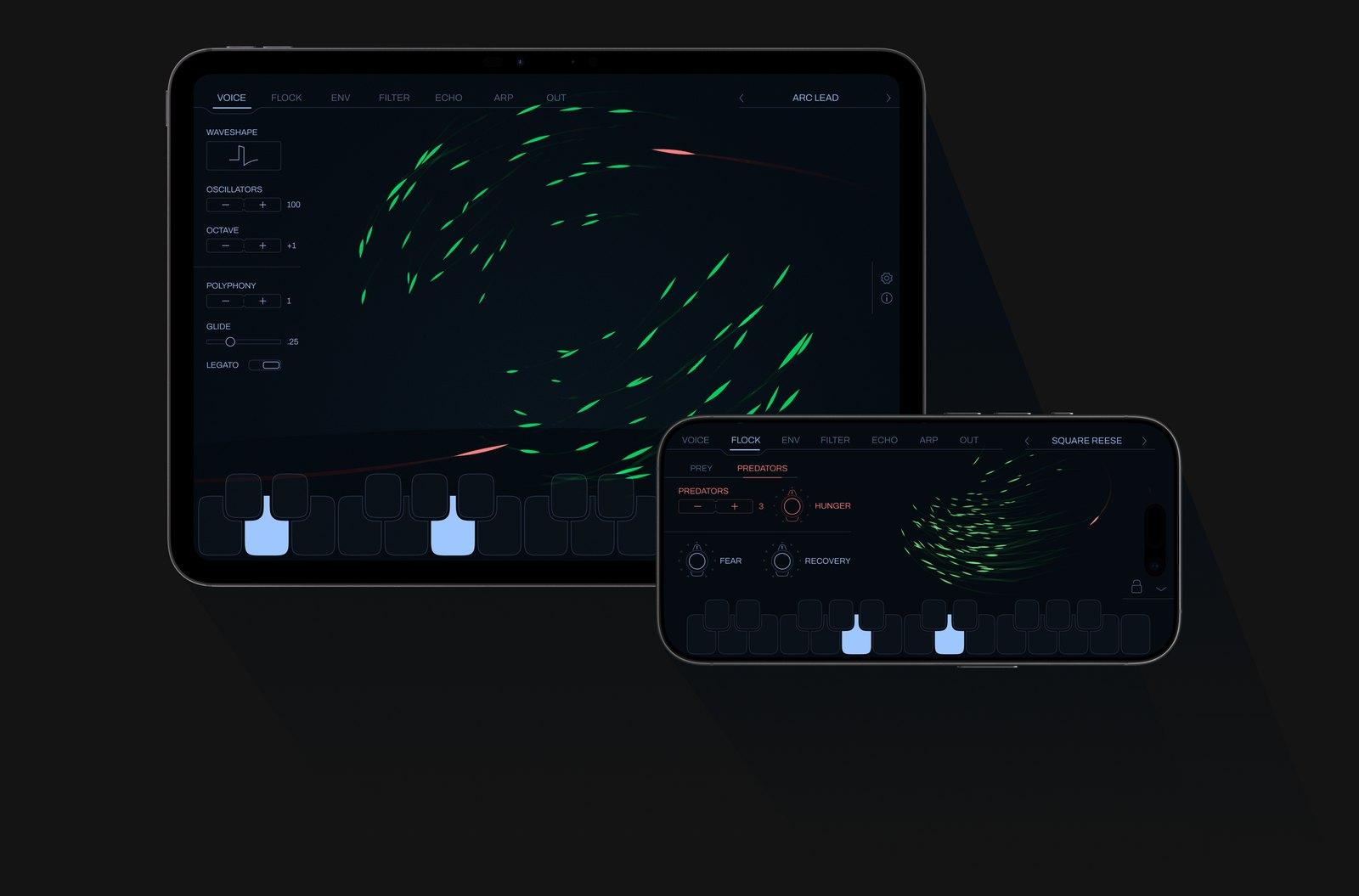
Hold a note in Photophore 2 and the oscillators keep moving. Up to 100 of them travel through a virtual 3D space, drifting in pitch and spreading across the stereo field as they go. A gentle flock can sound like a choir of synthesizers. Push the movement to extremes and it turns into a swarm of angry insects.
Taika Systems introduced flock synthesis on iPad in 2014. More than a decade later, Photophore 2 answers the longstanding request for AUv3 and brings the instrument to iPhone. The simulation also has a new source of disruption: predators that can send the flock scattering.
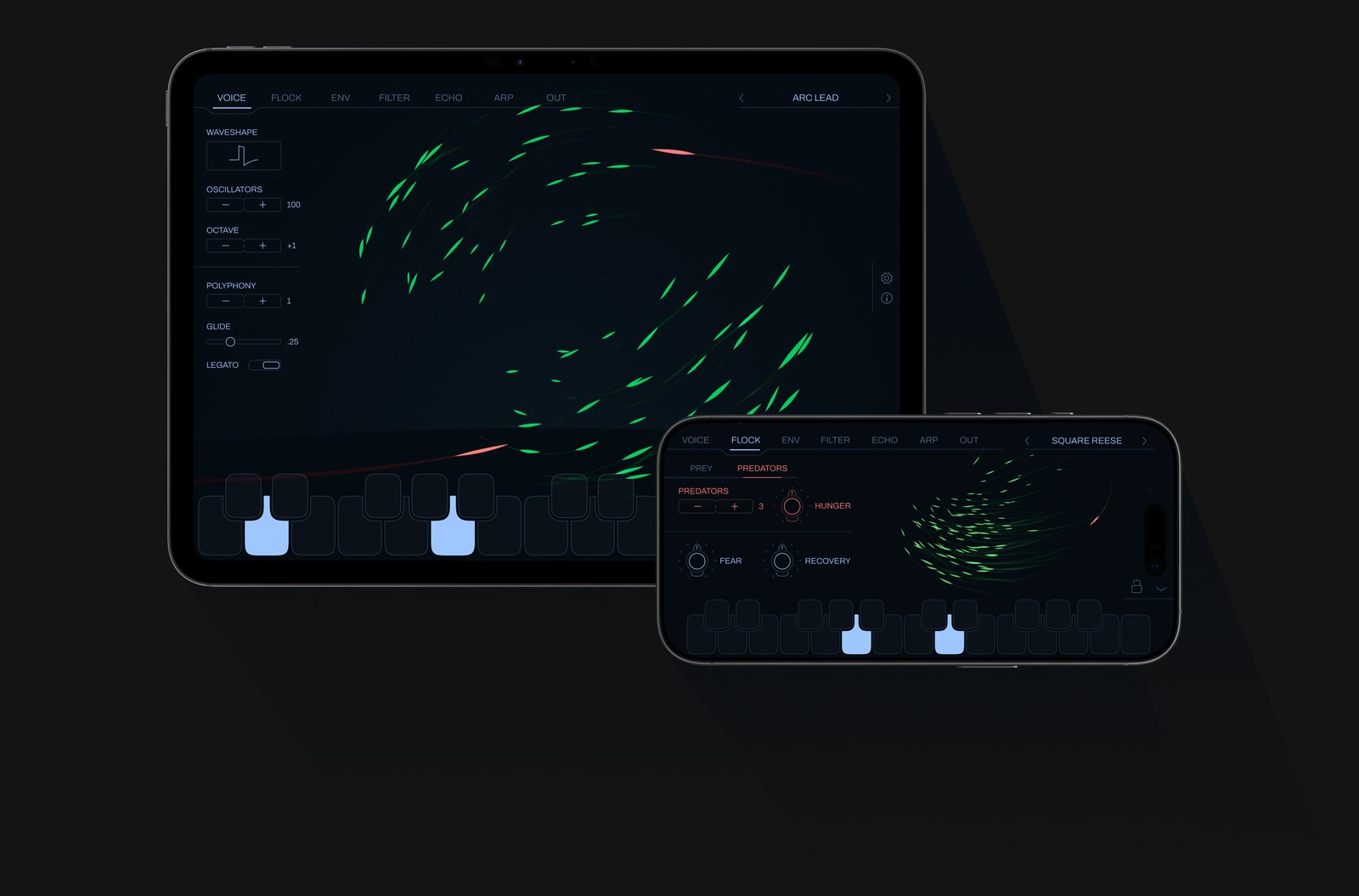 Arc Lead on the iPad’s VOICE page and Square Reese on the iPhone’s Predators page. Image: Taika Systems
How a flock becomes a sound
Photophore models animal behaviour. Each oscillator is a member of the flock, and the simulation determines how the group moves through its habitat. As members drift, their pitches drift with them. Each oscillator also moves audibly across the stereo field. A sustained note gives those small changes time to come through, as the stack shifts in tuning and its components change position.
The VOICE page sets up the sound with Waveshape, Oscillators and Octave, alongside the Polyphony, Glide and Legato controls. There are 12 waveforms, including saw, square, pulse and sine. The oscillator count determines how many members are in the flock, while polyphony governs how many notes you can play at once. Photophore supports up to six voices and has a mono mode with glide and legato for single-note lines.
Speed, turbulence and cohesion
On the FLOCK page, Speed governs how quickly the oscillators move and Turbulence shapes the disturbance in their surroundings. Attract, Repel and Align shape how the members stay together, avoid one another and line up in motion. Those settings keep a sustained note shifting independently of the amp and filter envelopes. Version 2 also adds two stereo modes and an additive width control, which shape how the flock spreads across the stereo field.
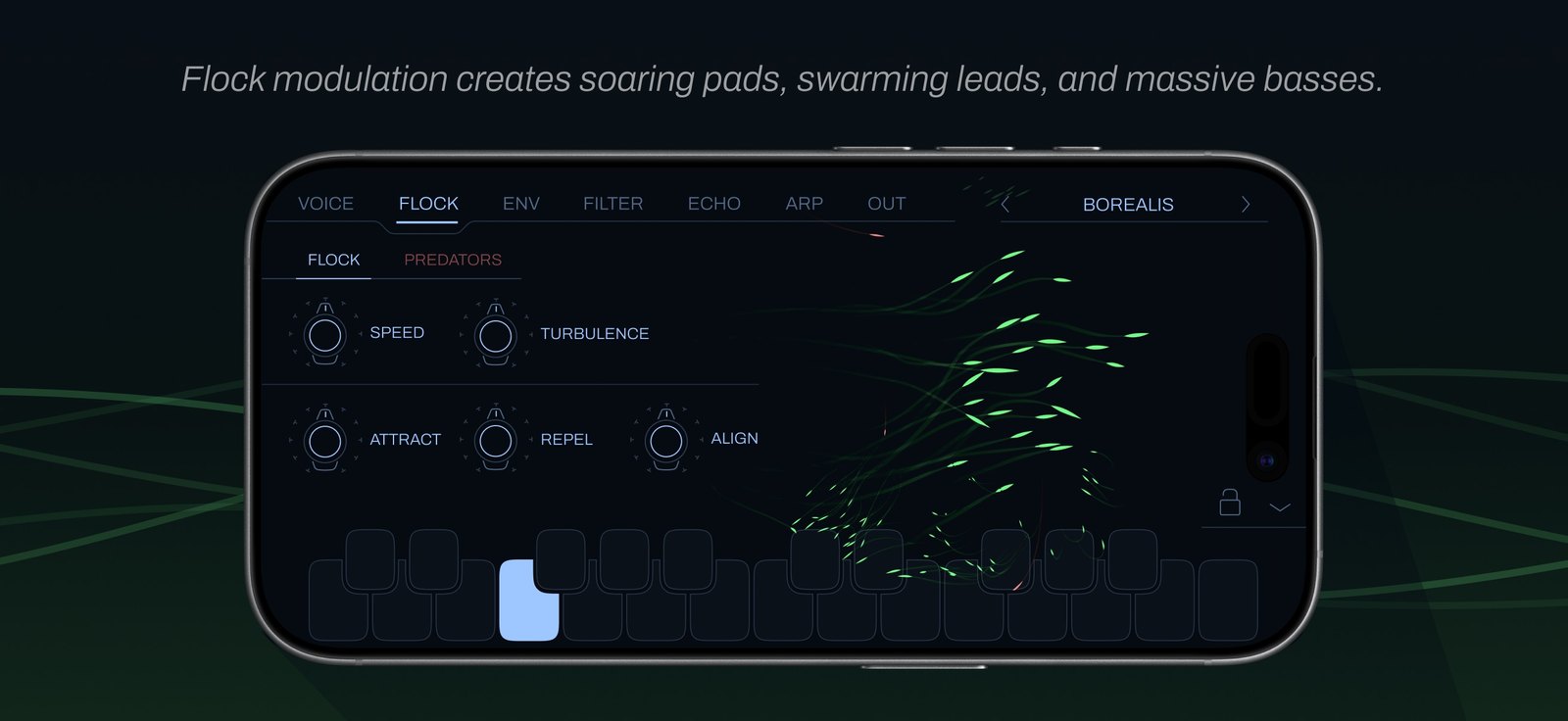 The FLOCK page in the Borealis preset, with Speed, Turbulence, Attract, Repel and Align. Image: Taika Systems
Try it: stack dozens of oscillators and keep Speed and Turbulence low. Hold a chord long enough to hear the gentle detuning and stereo movement within the pad.
Put predators in the flock
The FLOCK page has Prey and Predators tabs. On the Predators side, you can set how many predators enter the simulation and adjust Hunger, Fear and Recovery. Hunger and the flock’s fear give you a way to steer the amount of chaos. The resulting modulation is unpredictable, so a held note can keep changing as the flock responds.
Touch gives you a direct way to disturb the same group of oscillators. They scatter from your finger, and a swipe across the screen sends their pitches moving. With a MIDI keyboard, the modulation wheel controls flock motion, so you can vary the movement during a phrase while you play.
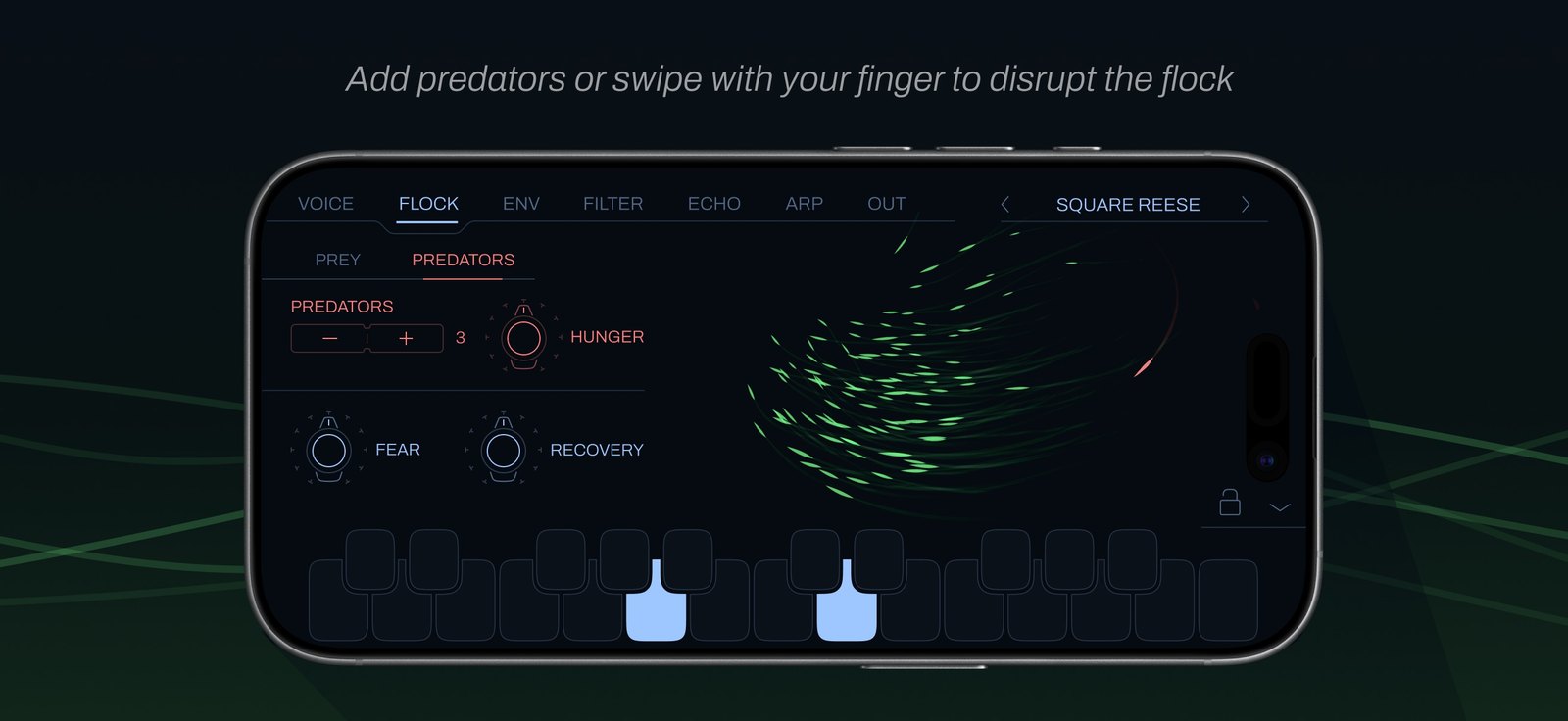 The Predators tab with three predators in the Square Reese preset. Image: Taika Systems
Try it: build a supersaw with a large flock of saw oscillators and turn Speed all the way up. Add predators for a more chaotic lead, or swipe the flock during a held note for a burst of pitch modulation.
From Reese bass to repeating patterns
The same drifting pitches that animate a pad can generate low-frequency interference for a modulated Reese bass: hold a low note and the shifting relationship between the oscillators does the work. A resonant low-pass/high-pass filter, dedicated amp and filter envelopes, and a stereo echo with warpable delay time shape the sound further.
The ARP page brings the notes into a repeating pattern. It has its own on/off switch, Tempo with tap entry and Direction. You can set it to cover one, two or three octaves and choose quarter, eighth, sixteenth or thirty-second notes in simple, dotted or triplet time. Keyboard latch lets you keep notes held while you turn to the flock controls.
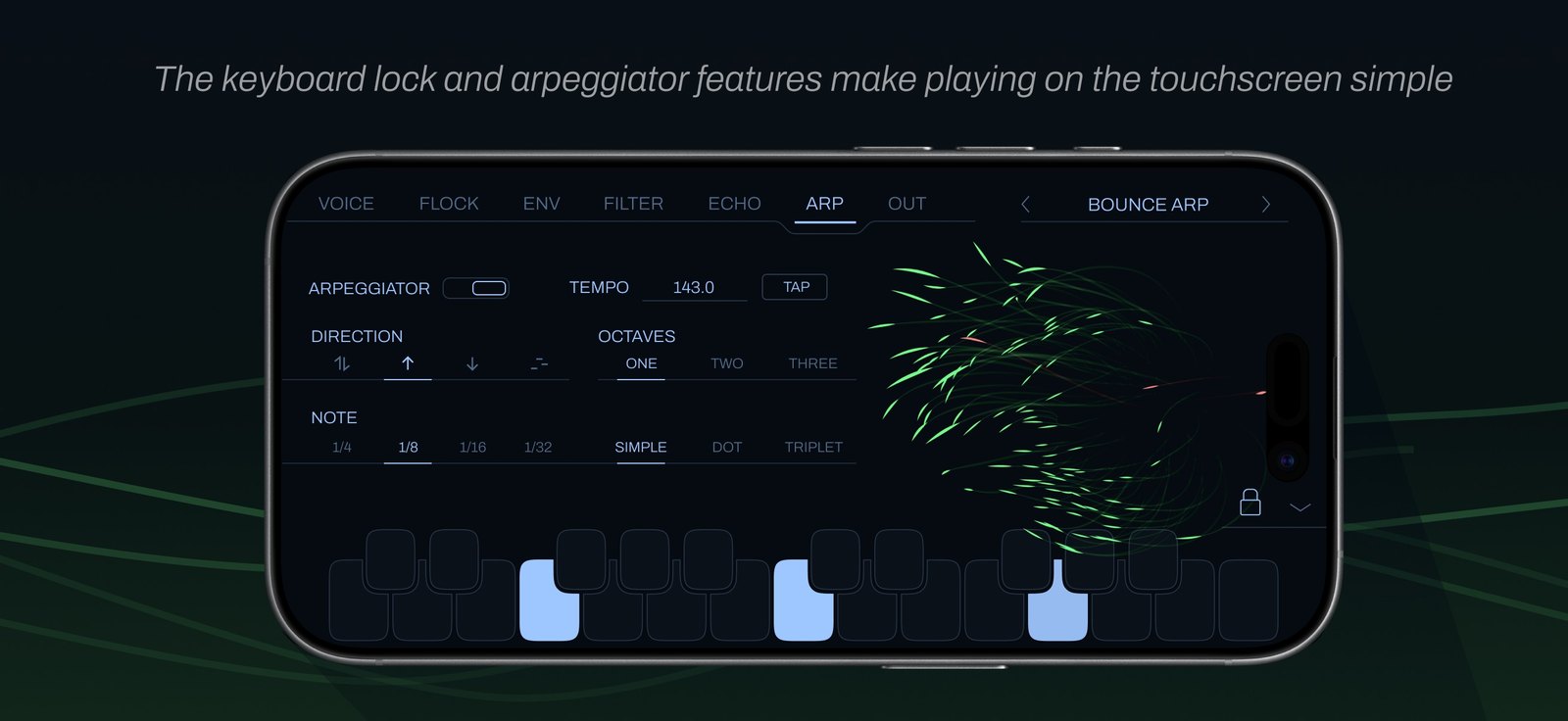 Bounce Arp on the ARP page, with the tempo display at 143.0. Image: Taika Systems
Try it: sync the arpeggiator to your host, choose eighth notes and latch a chord. Use the mod wheel to vary the flock motion while the arpeggiator keeps time.
Photophore in an AUv3 session
Photophore 2 opens as an AUv3 instrument in GarageBand, Logic Pro for iPad, AUM, Loopy Pro and other AUv3 hosts. The engine refinements make room for more plug-in instances, so a slow pad and a fast lead can each have their own flock in the same project. The universal app’s dark, minimal interface is optimised for iPhone as well as iPad, with smoother onscreen flock motion on current devices. There are also 30 new presets by Bop (Alexander Dmitriev).
Among iPad synths built around unconventional engines, 4Pockets SpectraPad builds sounds from the spectrum up. Photophore’s particular appeal is how much you can do with a single held note, from letting a pad drift to breaking up a lead with a swipe.
Price and availability
Photophore 2 costs $7.99 on the App Store. It requires an iPad or iPhone with an A12 chip or newer and iPadOS or iOS 15 or later. Visit Taika Systems for more on the instrument.
It suits ambient players after pads that evolve through a sustained chord, and bass and lead programmers who want the oscillator stack itself to supply the modulation.