Voltage Lab V: Pittsburgh Modular's West Coast Semi-Modular Synth Comes to iPad as an AUv3

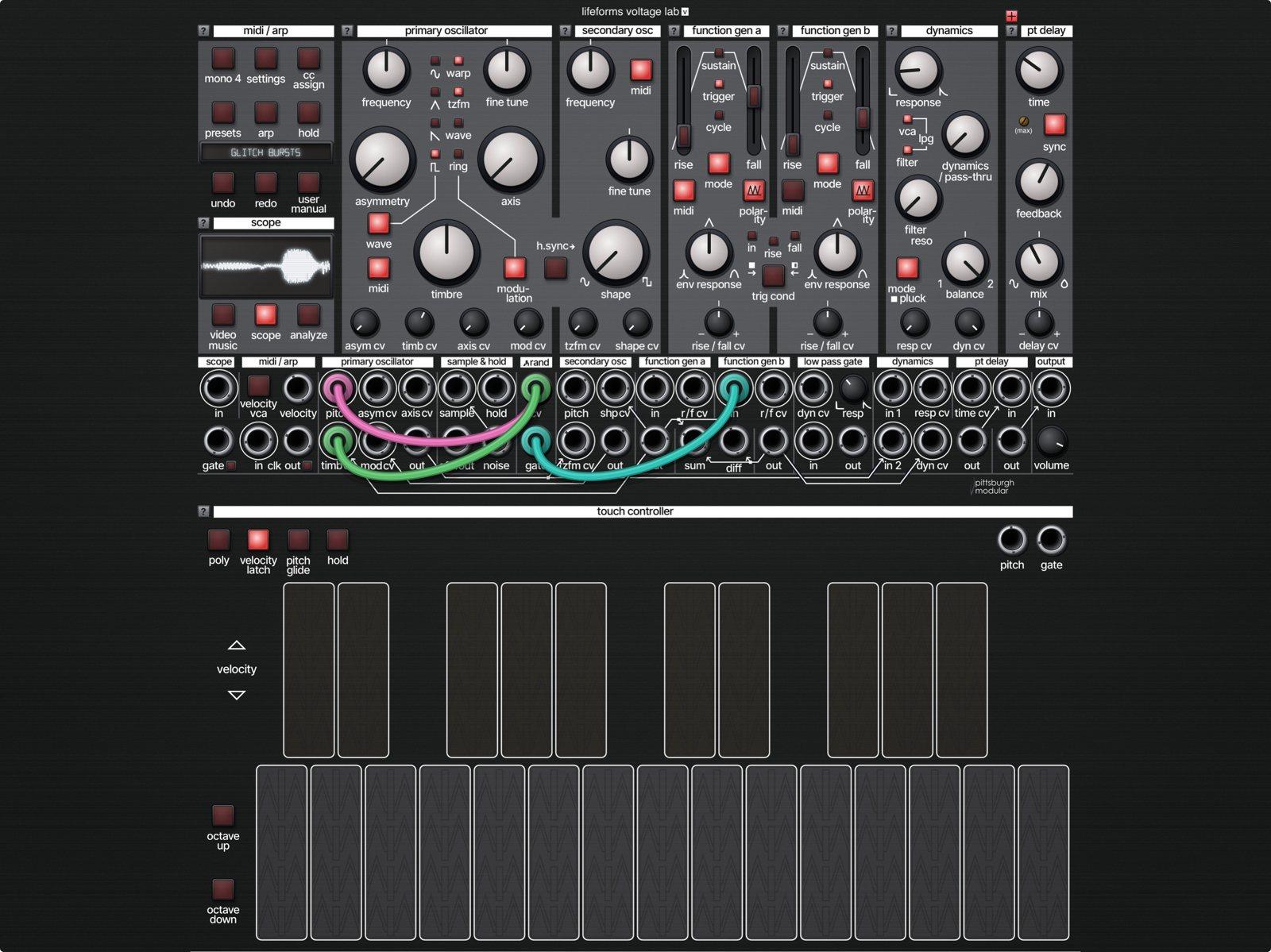
In 2019 Pittsburgh Modular took the Voltage Research Laboratory to Kickstarter. It was a semi-modular West Coast synth, and it was discontinued shortly after launch. Voltage Lab 2 followed later as hardware.
Now it is back, on iPad. Lifeforms Voltage Lab V, subtitled "Patchable Analog Synthesizer", arrived on the App Store on November 11 as a standalone app and an AUv3 instrument. It is built from the same schematics as the hardware.
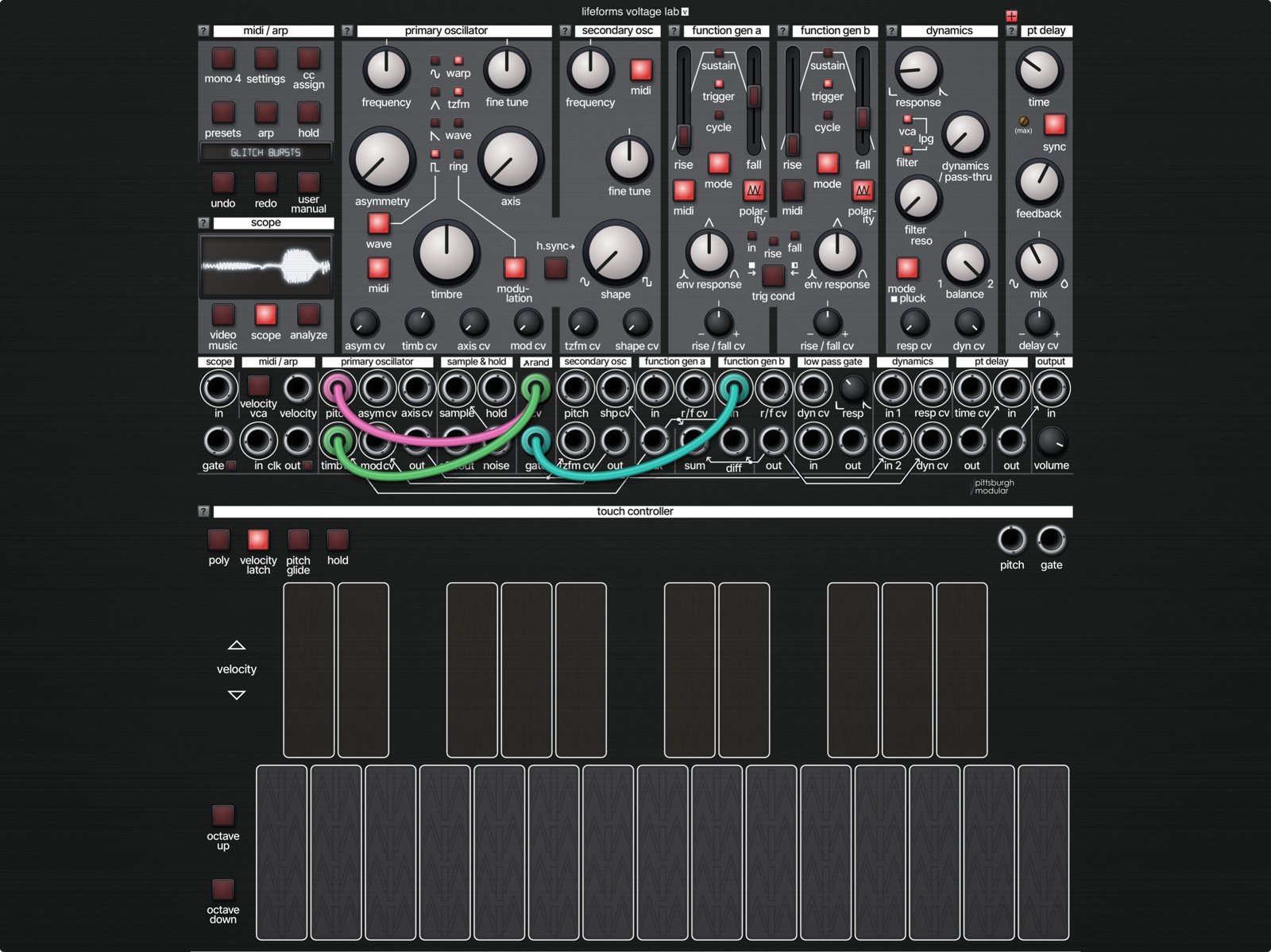 The full panel: modules along the top, the patch bay in the middle and the touch controller keyboard at the bottom. Image: Pittsburgh Modular
Built part by part
Pittsburgh's approach is component-level. Rather than approximating the sound of the instrument, it modelled how each section works, part by part, from the schematics used for the hardware. The oscillators, wavefolder, function generators, dynamics controller, delay and utilities come from the Voltage Lab Mini's schematics. The function generators draw on the analog function circuit of the Voltage Lab 2.
The patch cables matter here. They carry full audio-rate signals at the same voltages as the hardware, so feedback loops, cross-modulation and odd patches behave as they would on the real instrument. On a semi-modular, that is where much of the fun lives.
West Coast at heart
The original Voltage Lab explored the West Coast techniques Don Buchla developed in the 1970s. Pittsburgh's design pushed those ideas on. It was the first synth able to fold high-harmonic waveforms like saws and squares, and its Dynamics Controller modernised the low pass gate with adjustable decay times and voltage control over its percussive response.
The primary oscillator is the centre of it. A wide-range oscillator feeds a chain of wave shapers: asymmetry, axis offset, a switchable warp circuit and a six-stage wavefolder. Ring modulation and thru-zero FM sit on top. On the panel that means frequency, fine tune, asymmetry, axis, timbre, modulation and wave controls, with switches for warp, TZFM and ring.
The secondary oscillator runs from sine to square with shape CV and hard sync, so it can modulate the primary or play alongside it.
Two function generators work as envelopes, LFOs or slew limiters. Each has rise and fall sliders, cycle, sustain and trigger modes, and sum and difference outputs.
The dynamics controller is Pittsburgh's low pass gate, switchable between VCA, resonant filter, low pass gate, and low pass gate with pluck. A second low pass gate lives in the patch bay, so percussive strikes and plucks can go anywhere in a patch.
Round that off with sample and hold, noise, and a random source with adjustable morph, weight, variance, chance and wander, and there is plenty to patch into.
Try it: cable a cycling function generator into the timbre input of the primary oscillator, then slowly raise the timbre knob. Then set the dynamics controller to low pass gate with pluck and patch the second function generator into its CV input to shape each note.
Eight effects, patchable
Voltage Lab V has eight effects to choose from: a PT2399 delay, a BBD analog delay, Verb 28, a dense reverb, the granular Texture, a phaser, a chorus, and the Pittsburgh Filter, modelled on the company's Filter of Crows. They swap in and out like modules in a case. Use them at the end of the chain or patch them inside the synth, and modulate any of them from the patch bay.
Mono, Poly 6 and Mono 4
Play it monophonic like the original, or switch to Poly 6 for six-voice polyphony. The arpeggiator adds random octaves and can generate random arpeggios in a chosen key and scale. An oscilloscope, a spectrum analyzer and a "Video Music" display show what the patch is doing.
The on-screen touch plate keyboard has pitch and mod wheels, velocity, glide, hold and octave controls, and its pitch, gate and mod outputs can be patched anywhere. Multitouch lets you move several controls at once, play chords and re-patch while playing.
Mono 4 is the performance mode. It runs four independent Voltage Labs, each with its own sound, cables and MIDI channel, played from a four-column touch controller with quantized knobs, pads, and scan and step inputs. It takes its cue from the original Voltage Research Laboratory Touch Controller and from Pittsburgh's love of drone, soundscape and noise performance.
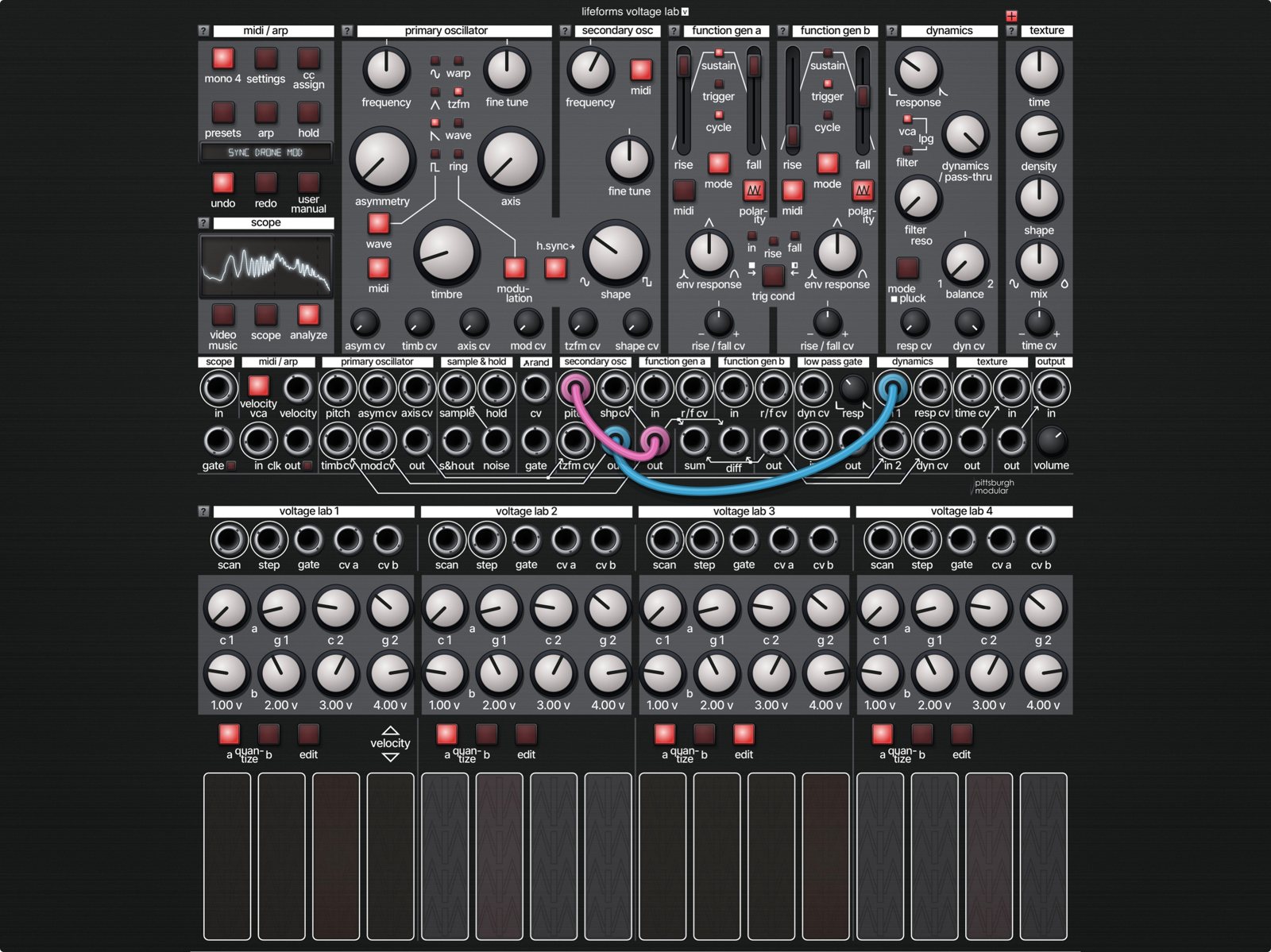 Mono 4: four complete Voltage Labs played from one touch controller. Image: Pittsburgh Modular
For other recent drone and generative instruments on iPad, see INERTIA Machine, a flywheel-driven noise and drone synth, and Terrarium Machine, a generative weather synth.
The hardware it models
Pittsburgh Modular's own walkthrough of the original 2019 Voltage Research Laboratory synth voice shows the hardware the app is built on.
In your host
As an AUv3, Voltage Lab V loads in AUM, GarageBand, Cubasis, Logic Pro for iPad and other hosts, and you can run multiple instances. It takes MIDI input, follows MIDI clock and syncs to the host, and CC assign maps external controllers to the panel.
It ships with 200 factory presets and 10 Mono 4 performance presets, with names such as Pad - Slow Fold, Keys - Tape Piano, Bass - TZFM Bass, Pluck - Sitar Buzz, Pluck - Kalimba, Lead - Ring Whistle, FX - Grain Smear, Generative - Sparse Chance and Weird - Feedback Howl. There are 100 steps of undo and preset import and export.
The manual is built in. Tap the ? in any section's title bar to open it.
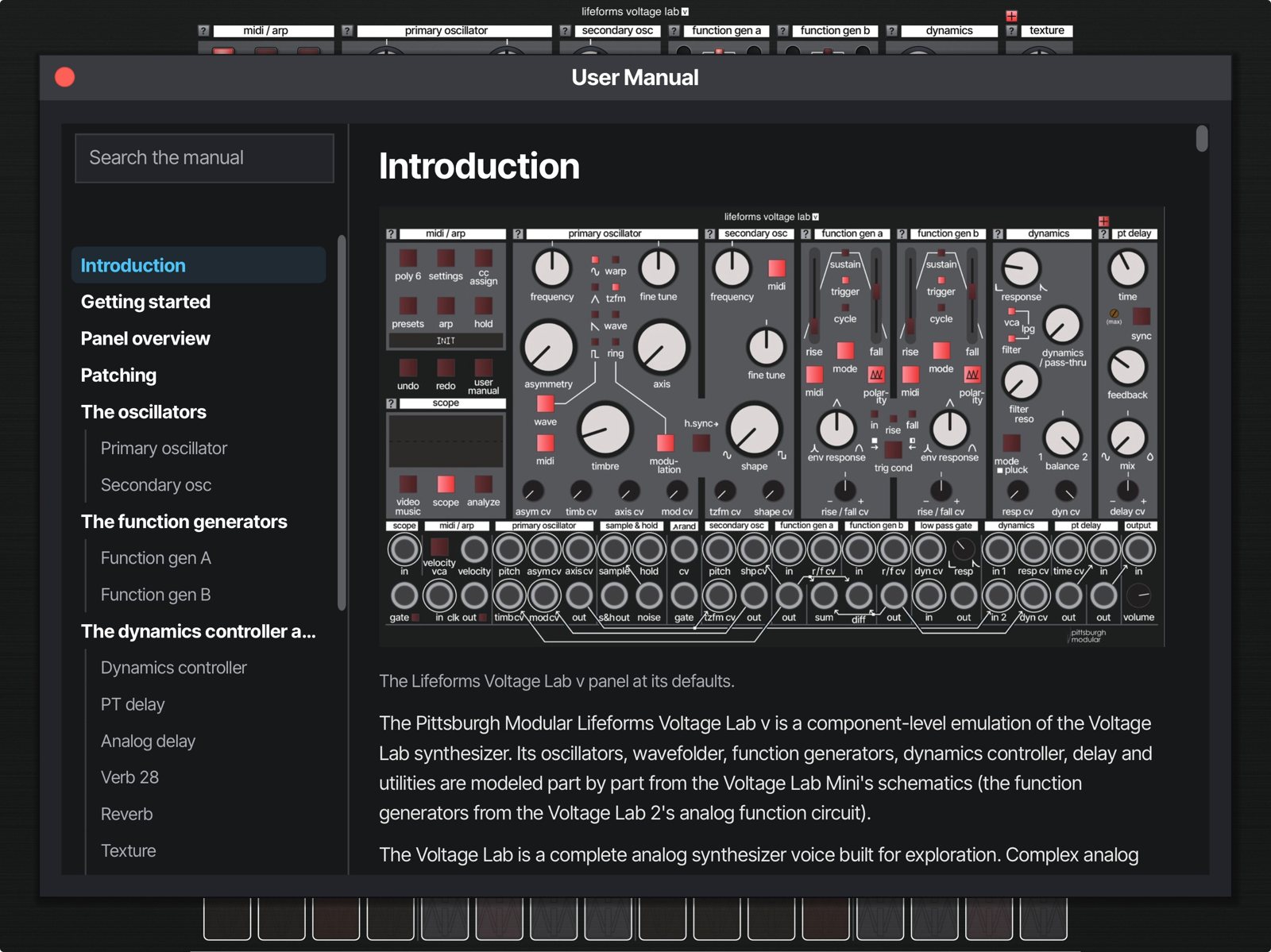 The built-in manual covers every module and effect. Image: Pittsburgh Modular
Start with the volume low. Resonance, feedback patches and long delays can raise the level suddenly.
Version 1.0.7, released November 21, adds fine-tune control of sliders and knobs, moves the preset name box out of the way of the pop-up keyboard when saving presets, and keeps the keyboard controller's active steps lit when hold is enabled.
For another hardware semi-modular on iPad, see our look at the Moog Grandmother and Matriarch emulation. Voltage Lab V also joins Pittsburgh's other software instruments, Lifeforms SV-1v and Microvolt 3901.
Price and availability
Lifeforms Voltage Lab V costs $19.99 on the US App Store. It is iPad only, needs iPadOS 15.0 or later, takes up 19.2 MB and needs no activation.
A desktop version for macOS (AU, VST3 and standalone) and Windows (VST3 and standalone) costs $49, with a 7-day free trial, from Pittsburgh Modular. Desktop and iPad are separate purchases.